👁 46 views
Every Sunday, the Old Man Ordered Breakfast for Two—But He Always Ate Alone
For eleven months, the old man ordered the same thing every Sunday morning.
Two coffees.
Two plates of scrambled eggs.
Four strips of bacon.
Two pieces of wheat toast.
And one blueberry pancake.
The strange part was that he always came alone.
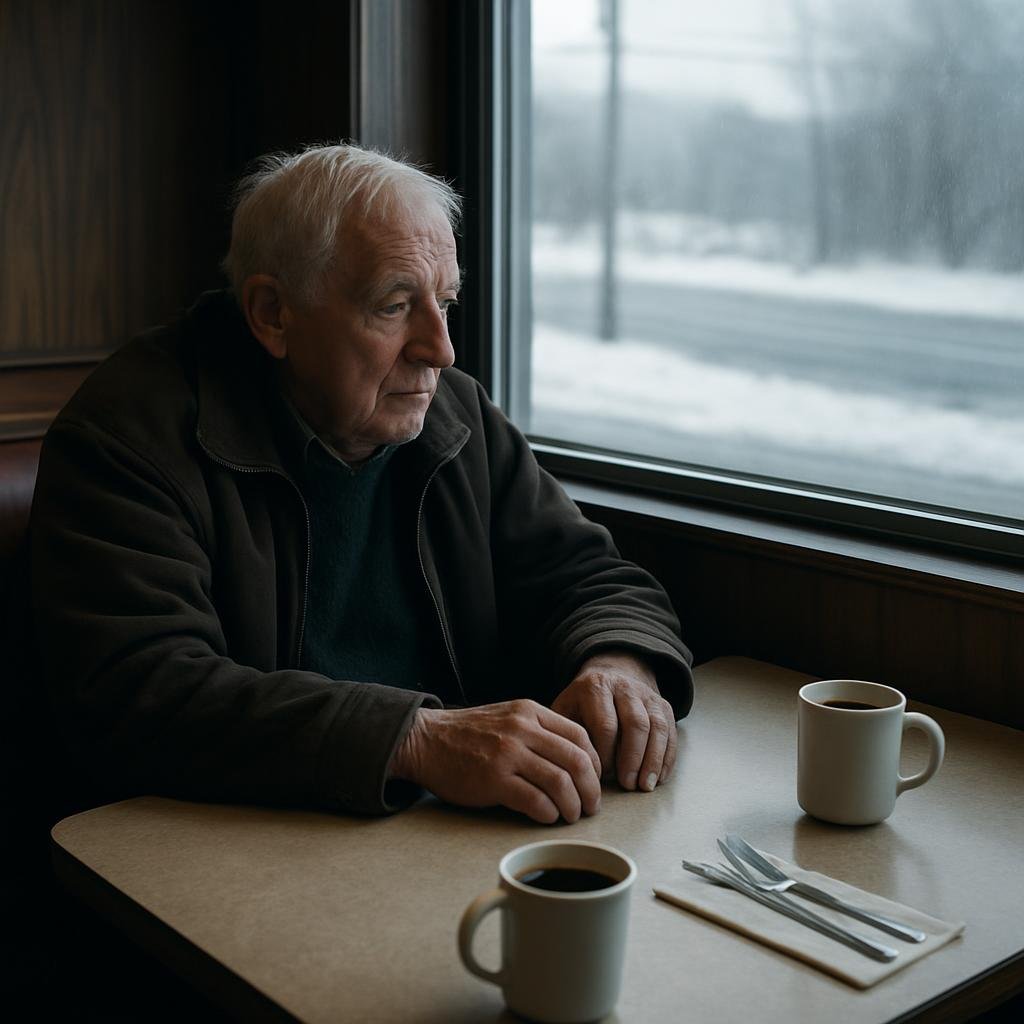
At exactly 7:10 every Sunday morning, his faded blue Ford pickup would pull into the parking lot of Millie’s Diner, a little roadside restaurant outside Columbus, Ohio.
The truck had rust around the wheel wells and a small American flag sticker fading on the back window.
The old man would step out slowly, close the door with both hands, and walk inside.
His name was Samuel Bennett.
Everyone called him Sam.
He was seventy-three years old, tall but slightly bent at the shoulders, with silver hair he combed carefully to one side.
And every Sunday, Sam asked for booth number six.
It was always the same booth.
The one beside the window.
“Morning, Sam,” waitress Rachel Morgan would say.
“Morning, kiddo.”
Rachel was thirty-six, although some mornings she felt sixty.
She had been working at Millie’s for almost eight years.
Her husband had left when their daughter, Emma, was two.
Since then, Rachel had built her life around double shifts, overdue utility bills, school lunches, and the constant fear that one broken transmission or hospital visit could destroy everything she had managed to hold together.
Still, she smiled at customers.
Especially Sam.
Rachel would bring him two cups of coffee.
She would place one in front of him.
And the other across the table.
Sam always added cream to the second cup.
Two little containers.
Never sugar.
Then he would sit quietly.
Sometimes for twenty minutes.
Sometimes longer.
He never touched the second breakfast.
Eventually, when the food became cold, Rachel would ask:
“You want me to box that up?”
Sam always gave the same answer.
“Not yet.”
The first few Sundays, Rachel assumed someone was coming.
A wife.
A brother.
Maybe an old friend.
But nobody ever did.
After three months, Rachel finally asked.
“Sam, can I ask you something?”
He looked up.
“Depends how expensive the answer is.”
Rachel smiled.
“Who are you waiting for?”
The smile disappeared from his face.
For a few seconds, he stared at the untouched coffee across from him.
Then he said:
“My daughter.”
Rachel glanced toward the door.
“She live around here?”
Sam slowly nodded.
“I believe so.”
Rachel wasn’t sure what that meant.
“You haven’t seen her in a while?”
“Thirty-one years.”
Rachel stopped wiping the table.
Thirty-one years.
She wanted to ask what happened.
But something in Sam’s eyes told her not to.
So she simply said:
“I hope she comes.”
Sam looked at the empty chair.
“So do I.”
Winter arrived early that year.
By December, snow covered the diner parking lot, and Rachel started keeping an old blanket in her car because the heater worked only when it felt like it.
Sam kept coming.
Every Sunday.
7:10.
Two breakfasts.
Two coffees.
Booth six.
One morning, Rachel noticed his hands shaking as he lifted his cup.
“You cold?”
“No.”
“You sure?”
Sam smiled.
“Getting old is just your body finding creative ways to complain.”
But something wasn’t right.
He had lost weight.
His cheeks looked hollow.
His shirts hung loosely around his shoulders.
Then, one Sunday in January, he didn’t come.
Rachel noticed immediately.
7:10 passed.
Then 7:30.
Then eight.
No blue Ford.
She told herself roads were icy.
At nine, she checked the parking lot again.
Nothing.
The following Sunday, booth six remained empty.
And the Sunday after that.
Rachel asked Millie’s owner if he knew where Sam lived.
Nobody did.
Sam paid cash.
He never talked much about himself.
He didn’t have social media.
He seemed to exist only between 7:10 and 8:30 on Sunday mornings.
Then, three weeks after Sam disappeared, Rachel arrived for work and saw a little girl standing outside the diner.
She couldn’t have been older than nine.
She wore a purple winter coat that looked one size too large and held a white envelope in both hands.
A woman stood beside her.
Probably her mother.
The girl looked through the diner window.
“Are you Rachel?”
Rachel froze.
“Yes.”
The little girl walked forward.
“My grandpa told me to give you this.”
Rachel stared at the envelope.
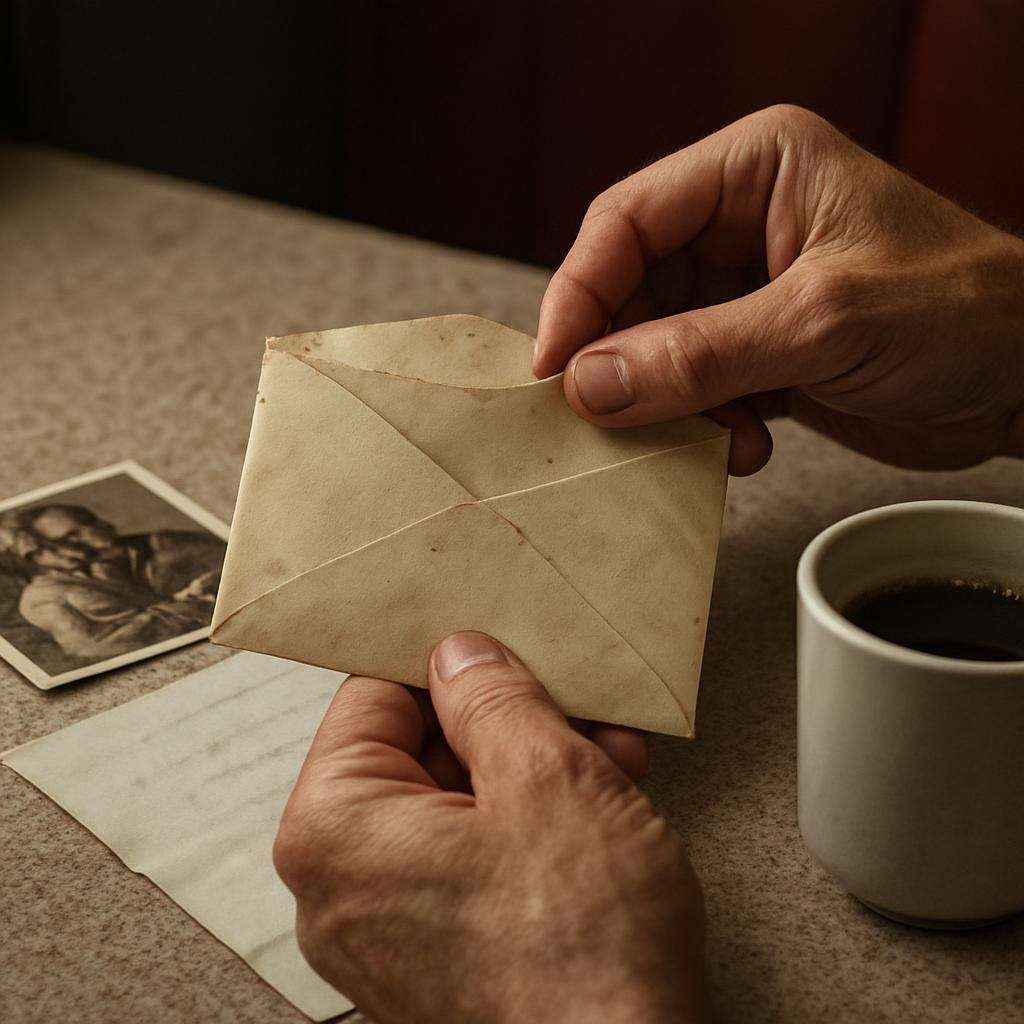
On the front, written in shaky handwriting, were four words:
FOR THE WAITRESS AT MILLIE’S.
Rachel’s stomach tightened.
“Your grandpa?”
The girl nodded.
“Samuel Bennett.”
Rachel immediately looked at the girl’s mother.
“Where is Sam?”
The woman lowered her eyes.
“He died Tuesday.”
For a moment, Rachel heard nothing.
Not the coffee machine.
Not the plates clattering behind her.
Not the conversation from the truck drivers near the counter.
Nothing.
“I’m sorry,” Rachel whispered.
The woman nodded.
“He had pancreatic cancer. By the time they found it, there wasn’t much they could do.”
Rachel covered her mouth.
Suddenly she understood the weight loss.
The shaking hands.
The missed Sundays.
The little girl held out the envelope again.
“He said you’d understand.”
But Rachel didn’t understand anything.
She opened it.
Inside was a letter.
And a photograph.
Rachel pulled out the photograph first.
It was old.
Maybe thirty years old.
A younger Sam stood beside a teenage girl in front of the same blue pickup truck.
The girl had long brown hair.
A wide smile.
And around her neck was a tiny silver heart necklace.
Rachel stopped breathing.
Because she knew that necklace.
She reached beneath the collar of her uniform and pulled out the necklace she had worn almost every day since childhood.
A tiny silver heart.
The exact same one.
Rachel looked at the photograph again.
Then at the woman standing in front of her.
Her hands began to shake.
“Who is this?”
The woman looked confused.
“Sam’s daughter. Claire.”
Rachel stared at her.
“That can’t be.”
“Why?”
Rachel turned the photograph over.
Written on the back were three words:
Claire. Age 17.
Rachel’s eyes filled with tears.
“My mother’s name was Claire.”
Nobody spoke.
Rachel unfolded Sam’s letter.
Dear Rachel,
If you’re reading this, I probably ran out of Sundays.
Rachel had to stop.
She wiped her eyes and continued.
I’ve been trying to tell you something for almost a year, but every time I walked through that diner door, I lost my nerve.
Thirty-one years ago, I had a daughter named Claire.
She was seventeen when she became pregnant.
I was not a good father then. I cared more about what the neighbors thought than what my daughter needed.
I told her she had embarrassed our family.
Those words cost me thirty-one years.
Rachel gripped the letter tighter.
Claire left Ohio shortly after you were born.
For years, I believed she had given you up for adoption. I later learned she had raised you herself under another last name.
Rachel’s knees weakened.
She sat in booth six.
The same booth Sam had occupied every Sunday.
I searched for Claire after your grandmother died. By the time I found her, I was too late. She had already passed away.
Rachel’s tears fell onto the page.
Her mother had died when Rachel was nineteen.
She rarely talked about her childhood.
She never mentioned her father.
Whenever Rachel asked about grandparents, Claire’s answer was always the same.
“Some doors are healthier left closed.”
Rachel had never pushed.
The letter continued.
But Claire left behind a daughter.
You.
Rachel looked toward the empty seat across from her.
A second cup of coffee.
Two breakfasts.
Every Sunday.
The room seemed to tilt.
The first Sunday I came to Millie’s, I didn’t know what I would say.
Then you walked to my table and asked if I wanted coffee.
You had Claire’s eyes.
I knew immediately.
Rachel began crying openly.
Her coworkers were watching now, but she didn’t care.
I should have told you that morning.
Instead, I got scared.
So I came back the next Sunday.
And the next.
I ordered breakfast for two because I kept telling myself that this would be the morning I finally asked you to sit down.
I imagined telling you everything over breakfast.
But how does a man explain that he lost his daughter because of his pride and then waited three decades to apologize to her child?
There isn’t a good sentence for that.
Rachel pressed the letter against her chest.
She remembered every Sunday.
Every untouched plate.
Every second cup of coffee.
Every time Sam looked toward the chair across from him.
He had never been waiting for someone to walk through the door.
He had been waiting for Rachel to sit down.
But the letter wasn’t finished.
There’s something else.
The little girl delivering this letter is Olivia.
Rachel looked toward the nine-year-old.
Olivia gave her a nervous little smile.
She’s your cousin.
My son Daniel and I repaired our relationship years ago. Olivia is his daughter.
Daniel knows about you. He wanted me to tell you the truth long before now.
He’s probably angry that I waited. He has every right to be.
Rachel glanced toward Olivia’s mother.
The woman nodded.
“Daniel is my husband.”
Rachel could barely process it.
Yesterday, she thought she had no extended family.
Today, a nine-year-old girl she had never met was standing in her diner calling Sam Grandpa.
Then Rachel reached the final paragraph.
I don’t expect forgiveness.
I learned too late that apologies don’t erase the years we waste being stubborn.
But I hope you won’t repeat my mistake.
Meet Daniel.
Meet Olivia.
Let Emma know she has family she hasn’t met yet.
Rachel stopped.
“How did he know my daughter’s name?”
Olivia’s mother smiled through tears.
“He asked about you all the time.”
Then she reached into her purse and removed another envelope.
“He left this too.”
Inside was a key.
Rachel looked confused.
“A key to what?”
“A house.”
Rachel almost laughed.
“What house?”
“Sam’s.”
“I don’t understand.”
“He left it to you and Daniel.”
Rachel stared at her.
“No. I can’t take his house.”
“There’s more.”
They drove there after Rachel’s shift.
Sam’s house sat twenty minutes outside town.
It was small.
White siding.
Green shutters.
A narrow porch.
Nothing about it looked expensive.
Daniel was waiting outside.
Rachel knew who he was before anyone introduced them.
He had her mother’s eyes too.
He walked toward her but stopped a few feet away.
Neither knew whether to shake hands or hug.
Finally Daniel said:
“I’ve wondered what you looked like for twenty years.”
Rachel laughed while crying.
“Apparently everybody knew about me except me.”
Daniel smiled.
“Pretty much.”
Then they hugged.
Inside Sam’s house, Rachel discovered why he had left her the key.
There was no fortune.
No secret millions.
No mansion.
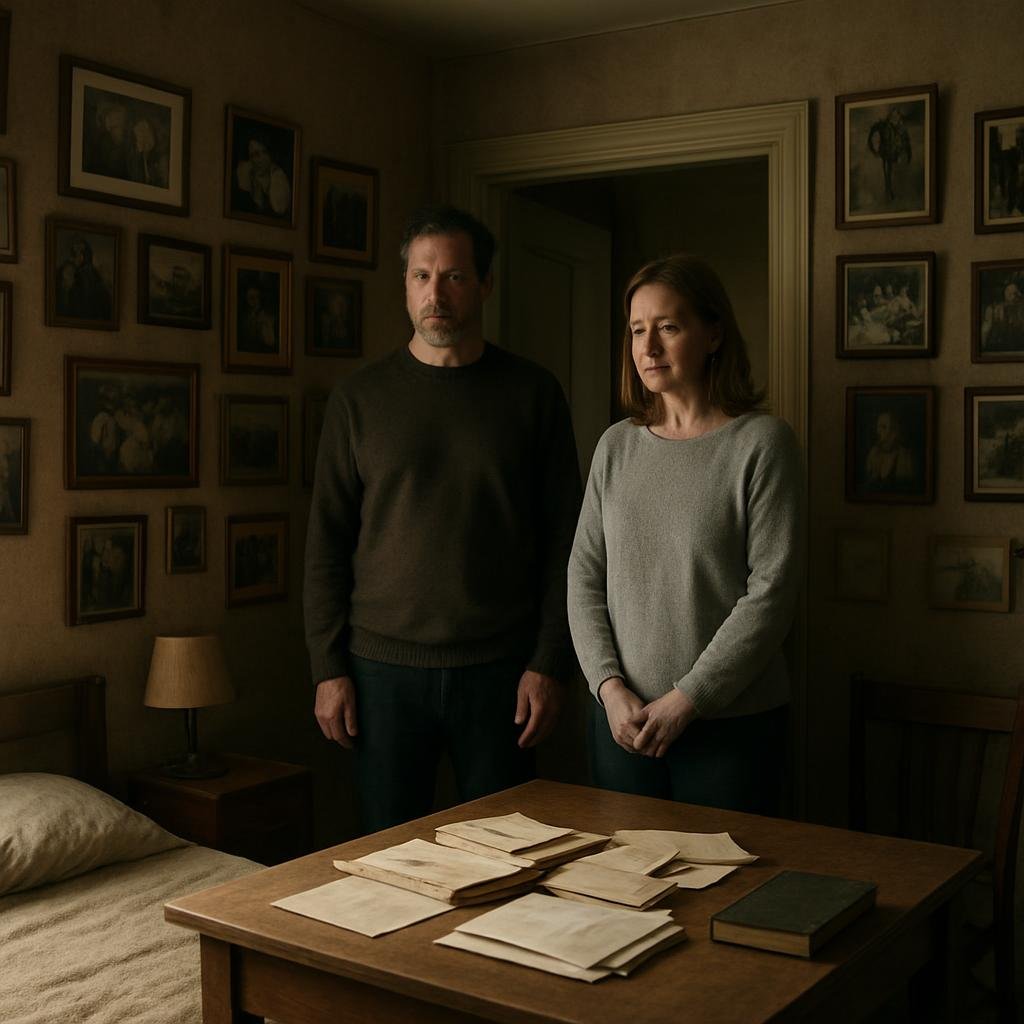
Instead, one bedroom had been converted into something that looked like an archive.
Three walls were covered with photographs.
Claire as a baby.
Claire on her first bicycle.
Claire at Christmas.
Claire graduating middle school.
Claire sitting on the hood of Sam’s truck.
And on the fourth wall were photographs of Rachel.
Her high-school graduation.
Her wedding.
Emma’s birth announcement.
Pictures from community events.
Newspaper clippings.
A photograph of Rachel standing outside Millie’s.
Rachel turned toward Daniel.
“He was watching me?”
“Not exactly.”
Daniel opened a desk drawer.
Inside were dozens of unopened envelopes.
Every envelope had Rachel’s name on it.
“He wrote you letters,” Daniel said.
“How many?”
“One every year on your birthday.”
Rachel stared at the stack.
Thirty-one letters.
None had been sent.
The first was written when Rachel was one year old.
The last only months earlier.
She opened the most recent.
The handwriting was shaky.
Dear Rachel,
Today you’re thirty-six.
I don’t know whether I’ll ever be brave enough to give you these letters.
Your mother would probably say I waited too long.
She would be right.
But I saw you today.
You were carrying groceries into your apartment while your little girl tried to catch snowflakes with her tongue.
You laughed exactly like Claire did.
Rachel couldn’t continue.
She sat on Sam’s bed and cried harder than she had cried since her mother’s funeral.
For years, she believed her family story ended with her mother’s death.
But it hadn’t ended.
It had simply been sitting twenty minutes away.
Waiting.
The following Sunday morning, Rachel arrived at Millie’s at 6:30.
Before opening, she placed a small RESERVED sign on booth six.
At 7:05, Daniel walked through the door with his wife and Olivia.
Emma came five minutes later after spending Saturday night at a friend’s house.
At 7:10 exactly, Rachel carried breakfast to the table.
Two coffees.
Scrambled eggs.
Bacon.
Wheat toast.
And one blueberry pancake.
Then she added more plates.
Daniel looked at the empty chair beside Rachel.
“You okay?”
Rachel nodded.
She placed Sam’s old photograph on the windowsill.
For nearly a year, Sam had ordered breakfast for two but eaten alone.
That Sunday, booth six held five people.
Before Rachel sat down, she poured one final cup of coffee and placed it near the photograph.
Two little containers of cream.
No sugar.
Emma looked at her mother.
“Who’s that for?”
Rachel stared at Sam’s smiling face.
“For somebody who spent too much of his life waiting.”
Then she sat beside her daughter.
And for the first time in thirty-one years, nobody in the Bennett family was waiting for someone else to make the first move.
Sometimes families aren’t destroyed by one terrible moment.
Sometimes they’re lost one quiet day at a time—
one phone call not made,
one apology delayed,
one door we are too proud to open.
And sometimes, if we’re lucky, someone opens it before there are no Sundays left.
The End