👁 74 views
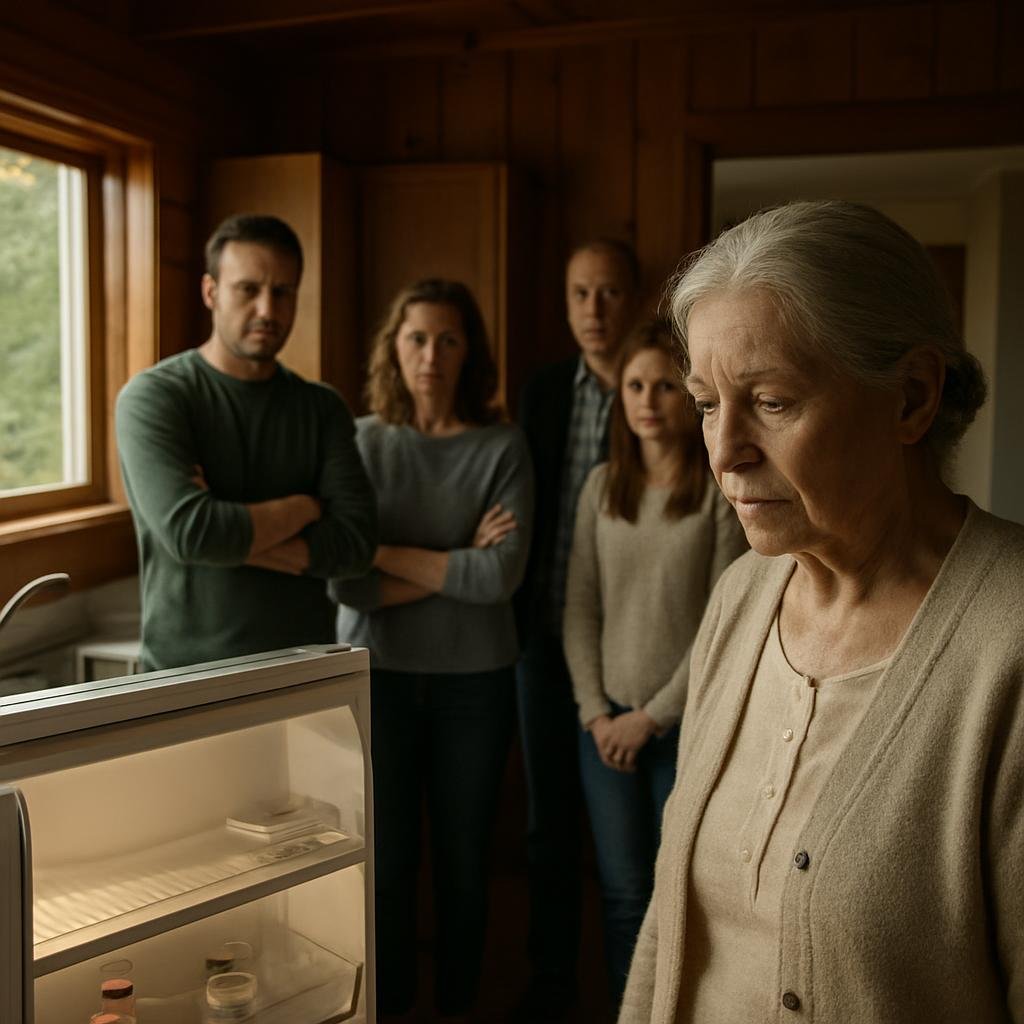
My daughter-in-law texted, “Get everything ready. We’ll be there at noon,” before coming to my lake house for a barbecue. As usual, she expected me to buy the steaks, clean the rooms, prepare the grill, and pay for everything. This time, I didn’t prepare a single thing. Then she arrived with two extra guests I had never invited, and when she opened my refrigerator, the look on her face told me she finally understood something had changed.
My name is Alice Bennett.
I’m sixty-eight, widowed, and I own a quiet lake house in northern Michigan.
My husband and I spent most of our adult lives working to pay for it.
After he died, my son David and his wife Sarah gradually started treating the place like their personal summer getaway.
For five years, the routine never really changed.
They announced they were coming.
I bought everything.
Steaks for David.
Wild-caught salmon for Sarah.
Cheese.
Fruit.
Craft beer.
Then I cleaned the bedrooms, changed the sheets, prepared the grill, cooked dinner, and cleaned the entire mess again after they left.
Most weekends, they showed up carrying luggage.
Nothing else.
I tolerated it because I was afraid that if I stopped making everything comfortable for them, they might stop visiting altogether.
Then Sarah sent me a text.
“Get everything ready. We’ll be there at noon.”
No greeting.
No question.
Just instructions.
Normally, I would have dropped whatever I was doing and hurried to the grocery store.
This time, I put my phone down and went back to working in the garden.
Around eleven, I made lunch for myself.
Leftover chicken.
A little salad.
Iced tea.
That was almost everything I had in the refrigerator.
At noon, David’s SUV pulled into the driveway.
Then another car appeared behind it.
Sarah got out first.
Behind her came her parents, Brenda and Tom.
Nobody had told me they were coming.
Nobody had asked whether I minded.
And nobody had brought a single bag of groceries.
Sarah dropped her overnight bag on the porch.
“Please tell me the grill is hot. We’re starving.”
Brenda gave me an awkward smile.
“Sarah said you were making a huge barbecue.”
I looked at Sarah.
Then at David.
“The grill is perfectly clean.”
Sarah frowned and walked inside.
A few seconds later, I heard her shout from the kitchen.
“Alice, where is all the food?”
She was standing in front of my open refrigerator.
Milk.
Ketchup.
A few leftovers.
Almost nothing else.
“Where are the groceries?”
“I didn’t buy any.”
She stared at me.
“I told you we were coming.”
“Yes,” I said. “You told me.”
“My parents drove three hours for this barbecue.”
“That was your decision, Sarah.”
David stepped into the kitchen.
“Mom, we always barbecue when we come here.”
“Usually.”
I looked straight at him.
“Usually you arrive with nothing, eat food I paid for, leave wet towels everywhere, and drive home while I clean up after everyone.”
The kitchen became very quiet.
Sarah’s face turned red.
“You’re embarrassing me in front of my parents.”
“I didn’t invite your parents.”
That stopped her.
“There’s a grocery store about twenty minutes away. You and David can buy whatever you want and cook it yourselves.”
David groaned.
“Mom, we just drove for hours.”
“You’re welcome to make oatmeal.”
Sarah pulled out her phone.
“Fine. I’ll order something.”
She tapped the screen several times.
Nothing happened.
“We’re too far outside town,” I said. “Nobody delivers out here.”
David finally sighed and reached for his car keys.
“Fine. I’ll go shopping.”
Then he held out his hand.
He was waiting for my credit card.
For years, I would have handed it over automatically.
Instead, I opened a drawer, took out a reusable grocery bag, and placed it in his hand.
He stared at the bag.
Then at me.
“Don’t forget charcoal,” I said. “You used the last bag and never replaced it.”
David walked outside without saying another word.
The second the door closed behind him, Sarah stepped closer to me.
“You planned this just to embarrass me.”
“No,” I said. “I simply stopped doing everything for you.”
Her eyes narrowed.
“We’re the only family you have left, Alice. Maybe you should remember that before deciding how you want to treat us.”
For years, that sentence would have terrified me.
This time, it didn’t.
I suddenly understood how much money, time, and energy I had spent every summer trying to keep people around who rarely made me feel wanted.
“If David stops coming because I won’t buy his steaks anymore,” I said, “that’s his choice.”
→
Sarah stood there, gaping, completely disarmed by my calm. She had traded on my loneliness for five years, weaponizing the fear of being an isolated widow to turn this house into a free resort. But once you stop being afraid of silence, a threat like that holds no teeth.
Out in the living room, her parents were hovering by the screen door, shifting uncomfortably. Brenda cleared her throat and gave her daughter a pointed, disapproving look.
“Sarah,” Brenda called through the kitchen archway, her voice laced with sharp embarrassment. “You told us Alice specifically asked you to invite us. You told us she loved hosting big weekends and had already bought everything.”
Sarah spun around, her cheeks burning crimson. “Mom, drop it—”
“No, I won’t drop it,” Brenda said, stepping into the kitchen and looking at me with genuine mortification. “Alice, I am so sorry. We had no idea. If I had known she pulled this, Tom and I would have brought coolers of food, or better yet, taken all of you out to a restaurant in town.”
Tom nodded solemnly from the hallway, his car keys already dangling from his fingers. “We don’t impose on people, Sarah. What on earth were you thinking?”
Sarah looked trapped between her parents’ shame and my total indifference. Before she could muster another defensive excuse, David returned from the driveway, his phone pressed to his ear and a heavy scowl on his face.
“Mom,” David said, stepping past the threshold, looking bewildered. “I went to check the boathouse to see if the boat was fueled up. The padlock is changed. The code doesn’t work. And the guest rooms upstairs… the doors are locked.”
“The boathouse is locked because the boat is being winterized and serviced next week,” I said smoothly, folding my arms. “And the bedrooms are locked because I didn’t clean them, strip the beds, or wash the linens. If you want to stay the night, the laundromat is next to the grocery store. You can buy detergent, wash the spare sheets in the cedar chest, and make your own beds.”
David stared at me, his mouth slack. “You’re serious?”
“Dead serious,” I replied. “This is my home, David. It is not an all-inclusive hotel. I am your mother, not your maid, your private chef, or your bank account. If you want to come here to spend time with me, to sit on the porch and talk like a son, the door will always be open. But if you come here expecting to be waited on hand and foot while you treat me like hired help, you can turn right around and book a motel.”
The silence hung heavy over the cedar-walled kitchen, broken only by the gentle lap of the lake water against the shore outside.
David looked at me, then at the empty countertops, and finally down at the cheap reusable bag in his hand. For the first time in five years, the entitled boy vanished, and the man I raised began to register the shameful reality of how he had treated his mother.
“She’s right, David,” Tom spoke up quietly from the back. “Get in your car. Brenda and I are driving into town to get a hotel room. If you two want to eat, you pay for your own lunch.”
Brenda gave me a warm, apologetic touch on the arm as she walked out. “Again, Alice, I’m so sorry. Next time we see you, we’re taking you out.”
Sarah stormed out of the house after her parents without another word, slamming the screen door so hard the frame rattled.
David stayed behind for a long moment, staring at his boots.
“Mom,” he began, his voice barely above a whisper. “I… I didn’t realize.”
“You did realize, David,” I said gently, but without budging an inch. “You just didn’t care because it was convenient for you. Go catch up with your wife. Think about what kind of relationship you actually want with me.”
David swallowed hard, nodded, and walked out the door with his shoulders slumped.
A few minutes later, two sets of tires crunched over the gravel driveway and faded down the pine-lined road.
I took a deep breath, walked out onto the screened back porch, and sat down on the wicker rocking chair with my glass of iced tea. The breeze off the water was crisp and sweet, carrying the scent of cedar and pine. The house was quiet, clean, and completely mine. And for the first time in five long years, I wasn’t lonely at all.
The End