👁 60 views
My parents changed the locks on my house while I was at work and handed the new keys to my brother.
When I confronted them, my mother looked me straight in the eye and said,
“Daniel needs this house more than you do.”
What none of them knew was that six weeks earlier, I had discovered someone was already trying to transfer the property out of my name.
So I had quietly changed something far more important than the locks.
My name is Rebecca Lawson.
I was thirty-seven when my family decided the house I had spent fifteen years paying for should belong to my older brother because his marriage was falling apart.
The house was not a mansion.
It was an old two-story farmhouse outside Asheville, North Carolina, with white siding, a deep front porch, three bedrooms, and nearly eight acres of land.
But to me, it was priceless.
My grandmother Eleanor had lived there for almost fifty years.
When I was a child, I spent summers picking tomatoes from her garden, feeding apples to the neighbor’s horses, and sitting beside her on the porch during thunderstorms.
She died when I was twenty-two.
She left the property to me.
Not to my parents.
Not to my brother.
Me.
There was one problem.
The house still carried a significant mortgage, needed major structural repairs, and had years of deferred maintenance.
My parents told me immediately to sell it.
“You’re twenty-two,” Dad said. “You don’t need an old farmhouse.”
Daniel agreed.
“Take the money and get an apartment in the city.”
I refused.
Maybe it was sentimental.
Maybe I was stubborn.
Either way, I kept it.
For the next fifteen years, I poured nearly everything I had into that place.
I replaced the roof.
Repaired the foundation.
Updated the electrical system.
Installed new plumbing.
Restored the original hardwood floors.
I worked as a commercial interior designer during the day and took freelance jobs at night.
Some months, almost my entire paycheck disappeared into repairs.
My parents contributed nothing.
Daniel contributed even less.
But somehow, after the house became beautiful, everyone started calling it “the family property.”
I corrected them every time.
“It’s my property.”
Mom would smile.
“You know what we mean.”
Unfortunately, I did.
Daniel had always been the person my parents rescued.
When he quit college, Dad paid his credit-card debt.
When his first business failed, my parents covered six months of his mortgage.
When he bought a boat he couldn’t afford, Mom called it “a mistake anyone could make.”
When I needed help repairing a collapsed section of the farmhouse porch at twenty-six, Dad told me,
“You chose to keep that house. You need to learn responsibility.”
I remembered those words very clearly.
Apparently, he did not.
Daniel married Vanessa when he was thirty-four.
For the first few years, they looked wealthy from the outside.
Large suburban home.
Two luxury SUVs.
Country club membership.
Expensive vacations.
Private school for their son.
Then their marriage began collapsing.
Daniel had made several terrible investments without telling Vanessa.
He had also taken money from a home-equity line to finance a restaurant venture that closed in eleven months.
When Vanessa filed for divorce, everything exploded.
The marital house was heavily leveraged.
Their savings were nearly gone.
Daniel’s attorney warned him that after property division and legal fees, he might have very little left.
That was when my parents suddenly became interested in my farmhouse.
It started with a Sunday lunch.
Mom made pot roast.
Dad poured everyone wine.
Daniel sat across from me looking exhausted.
Halfway through dinner, Dad folded his hands.
“We need to discuss something as a family.”
I almost laughed.
In my family, those words usually meant Daniel needed money.
Dad continued.
“Daniel needs somewhere stable for Ethan.”
Ethan was my nine-year-old nephew.
I loved him.
None of this was his fault.
I looked at Daniel.
“What happened to the house?”
“Vanessa wants it sold,” he said.
“And?”
“And I probably can’t afford another place right away.”
Mom touched my arm.
“You have three bedrooms.”
There it was.
I pulled my arm away.
“If Daniel needs somewhere temporary, Ethan can stay with me whenever necessary.”
Daniel frowned.
“And me?”
“There are apartments.”
Dad stared at me.
“You’re really going to make your brother rent some little apartment while you live alone in that huge house?”
“My house is fifteen hundred square feet.”
“You know what I mean.”
Again, I did.
Then Mom said it.
“We think you should sign the farmhouse over to Daniel.”
I stared at her.
At first, I genuinely thought I had misunderstood.
“Excuse me?”
“Not forever,” she said quickly.
“Just until the divorce is settled.”
Daniel leaned back.
“My attorney said if the property isn’t connected to the marriage, Vanessa can’t touch it.”
That sentence told me everything.
This was not about giving Daniel somewhere to sleep.
They wanted to move an asset into his hands.
My asset.
I put down my fork.
“No.”
Dad sighed like I was a difficult employee.
“Rebecca.”
“No.”
“Your brother could lose everything.”
“He already spent everything.”
Daniel’s face hardened.
“You don’t know what happened in my marriage.”
“I know what’s happening to my house.”
Mom lowered her voice.
“Your grandmother would want family to help family.”
That made me angry.
“Grandma left the house to me.”
“Because you were the responsible one,” Dad said.
“Exactly.”
Nobody spoke for several seconds.
Then Dad delivered the ultimatum.
“If you refuse to help Daniel when he needs you most, don’t expect us to continue treating you like part of this family.”
I stood up.
I grabbed my purse.
And I said,
“That threat would probably work better if being part of this family didn’t always involve paying Daniel’s bills.”
Mom gasped.
Daniel called me selfish.
Dad ordered me to sit down.
I left.
I thought that was the end of it.
It wasn’t.
Three days later, I received an email from the county recorder’s office.
The subject line read:
PROPERTY DOCUMENT ALERT.
I almost deleted it.
Months earlier, my attorney had recommended I enroll in a fraud-notification system because property scams had increased in our area.
I opened the email.
A document had been submitted containing my property address.
I called my attorney, Priya Shah.
“Can you look at this?”
Twenty minutes later, she called me back.
Her voice was different.
“Rebecca, did you sign a quitclaim deed?”
My stomach dropped.
“No.”
“Did you authorize anyone to prepare one?”
“No.”
There was a pause.
“Someone created a document attempting to transfer an interest in your property.”
I sat very still.
“To who?”
“Your brother.”
For a second, I could hear nothing except the air conditioner in my office.
“How?”
“The deed contains what appears to be your signature.”
“It isn’t.”
“I assumed that.”
The filing had not been fully accepted because of inconsistencies in the notarization.
But someone had tried.
Priya immediately contacted the recorder’s office, documented the suspected forgery, and recommended several precautions.
The next day, we took the biggest one.
I transferred ownership of the farmhouse into an irrevocable property trust structured by Priya’s firm, with me as the primary beneficiary and an independent trustee controlling any transfer.
No one could simply show up with a piece of paper bearing my signature and move the house somewhere else.
I also replaced my basic alarm system.
Eight cameras went up around the property.
Door sensors.
Cloud recording.
Motion alerts.
Electronic locks.
I told no one in my family.
Then I waited.
Two weeks passed.
Mom called twice.
Daniel sent several messages.
Dad left one voicemail saying,
“You still have time to fix this.”
I saved it.
Then on a Wednesday afternoon, while I was presenting design plans to a client, my phone buzzed.
FRONT DOOR ACCESS FAILURE.
Then again.
SIDE ENTRY OPEN.
I excused myself and stepped into the hallway.
I opened the camera app.
A white pickup truck was parked beside my house.
My father’s truck.
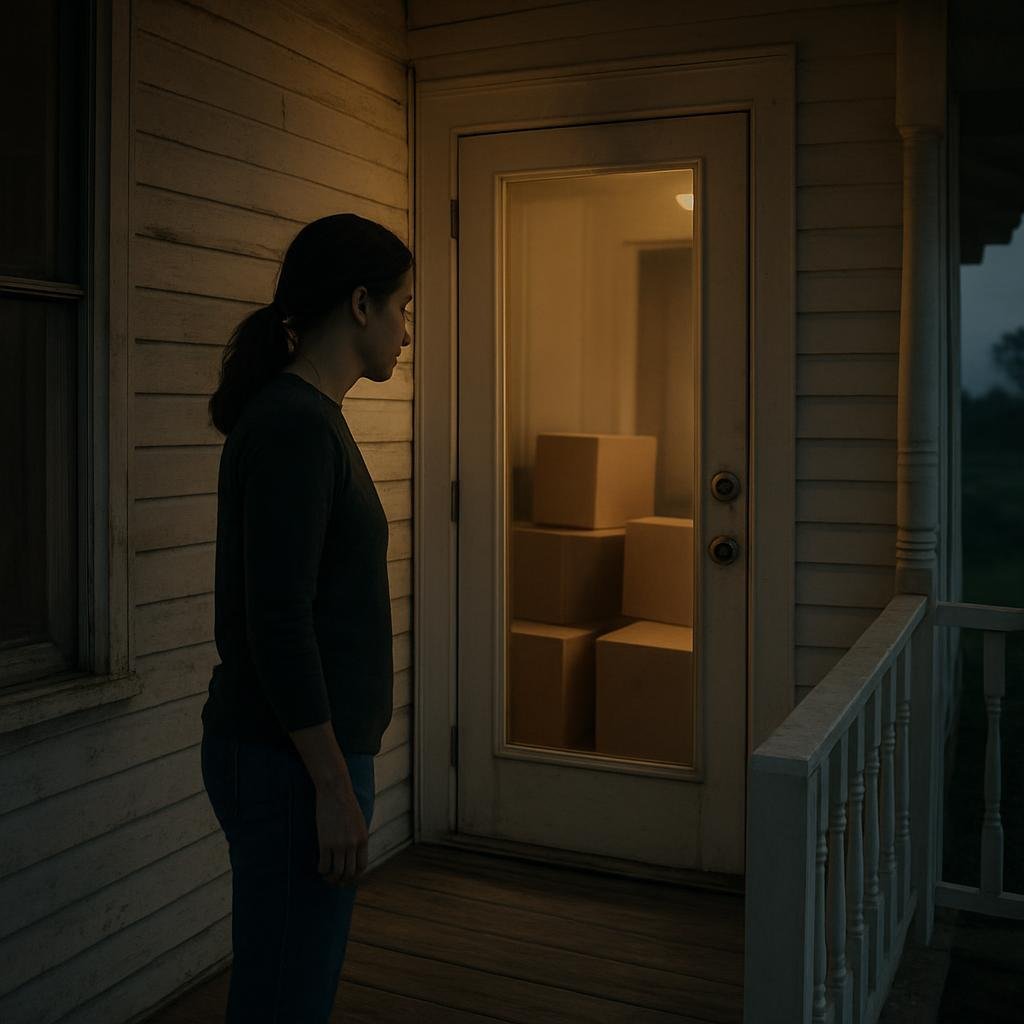
Dad stood on my porch.
Daniel was beside him.
Mom was holding a cardboard box.
A locksmith was changing my front-door lock.
For several seconds, I simply watched.
I could not believe what I was seeing.
Then another car pulled up.
Daniel began unloading suitcases.
His suitcases.
My mother walked into my house carrying new curtains.
I called the police.
Then I called Priya.
“They’re inside.”
“Who?”
“My parents. Daniel. They changed my locks.”
“Do not go home.”
“I’m watching them carry his things inside.”
“Rebecca, listen to me. Let the police handle it.”
I kept watching.
Daniel carried boxes upstairs.
Mom removed photographs from my living-room shelves and stacked them on the dining table.
Dad went into my office.
Then Daniel said something that the interior camera microphone captured perfectly.
“Once I establish residency, she can’t just throw me out.”
Dad replied,
“She’ll calm down eventually.”
Mom laughed.
“She always does.”
I did not calm down.
The police arrived eleven minutes later.
I watched through the cameras as two officers walked onto the porch.
Dad immediately began explaining.
“Our daughter gave her brother permission to stay.”
No, I hadn’t.
Mom said it was a family misunderstanding.
Daniel claimed he believed the house had been transferred to him.
That sentence became important later.
The officers called me.
I confirmed that nobody had permission to enter or live there.
Then one officer asked,
“Ma’am, do you know anything about paperwork showing your brother has ownership rights?”
My heart started pounding.
“Yes,” I said. “My attorney is already investigating a forged deed.”
Everything changed after that.
Daniel was escorted out.
My parents left shortly afterward.
The locksmith looked like he wanted to disappear.
When I finally returned home that evening, my living room was filled with Daniel’s boxes.
My photographs had been removed.
My grandmother’s antique table had been pushed against the wall.
And on the kitchen counter was a folder.
Inside was a printed document titled:
FAMILY PROPERTY AGREEMENT.
According to it, I had supposedly agreed to give Daniel exclusive occupancy of the farmhouse for five years.
My signature appeared at the bottom.
Again.
I had never seen it before.
I photographed everything.
Then I called Priya.
The next morning, we met in her office.
She looked through the documents quietly.
“This is getting much worse for them.”
“Them?”
She looked at me.
“Rebecca, I don’t think Daniel did this alone.”
She pointed to the witness section.
My mother’s name was there.
Then to a typed statement claiming the farmhouse had always been intended as a shared family asset.
My father’s name appeared beneath it.
I felt sick.
They had not simply tried to pressure me.
They had created documents designed to make their story look legitimate.
Priya had already requested copies of the rejected deed filing.
When they arrived, we saw something even more damaging.
The notary seal belonged to a woman who had retired almost two years earlier.
She denied notarizing anything.
The signature was fake.
The investigators now had a suspected forged deed, a second false agreement, security video showing unauthorized entry, audio discussing how to establish Daniel’s residency, and written statements from my parents supporting his supposed ownership.
My family had wanted a house.
Instead, they had created evidence.
Still, they believed they could intimidate me.
Mom called the following night.
“You called the police on your own father.”
“You broke into my house.”
“It isn’t a break-in when family has a key.”
“You hired a locksmith.”
“You’re twisting this.”
“No. The cameras are extremely clear.”
She went silent.
Then she said,
“What cameras?”
I almost smiled.
“The ones you walked past.”
The call ended thirty seconds later.
Three days after that, Dad appeared at Priya’s office with Daniel and another attorney.
They demanded a family meeting.
Priya recommended I attend only if their attorney was present.
So we sat around a conference table the following Monday.
Dad looked furious.
Mom looked offended.
Daniel looked nervous for the first time.
Their attorney did most of the talking.
He called everything a “misunderstanding regarding family expectations.”
Priya placed the first forged deed on the table.
“Was this also a misunderstanding?”
Nobody answered.
Then she placed the fake occupancy agreement beside it.
Mom looked at Daniel.
Daniel looked at Dad.
Their attorney removed his glasses.
“Where did this document come from?”
That was the moment I realized they had not even told their own lawyer everything.
Priya continued.
“The homeowner never signed either document.”
Dad finally spoke.
“We were trying to protect our son.”
“By forging my name?”
Mom snapped,
“You have no children. You don’t understand what parents will do.”
I stared at her.
“You have two children.”
She stopped talking.
Priya explained that the property was now held in a trust.
Even if they somehow produced another fake signature from me, I no longer had unilateral authority to transfer the house.
Daniel frowned.
“What do you mean, trust?”
“It means,” I said, “you were trying to steal a house I couldn’t legally hand you even if I wanted to.”
His face changed.
For weeks, they had believed they were one signature away from winning.
They were not.
But the trust was only part of the problem.
The county investigator had referred the suspected forgery to law enforcement.
The locksmith had provided a statement confirming Dad represented himself as someone authorized to change the locks.
The security footage preserved everything.
And then Priya revealed the detail that completely destroyed Daniel’s explanation.
When investigators reviewed his phone records under the warrant connected to the document investigation, they found messages between him and Dad.
One read:
If Becky won’t sign, we make it look like she already did.
Another said:
Once my stuff is inside, she’ll have a hell of a time getting me out.
My mother had replied with a thumbs-up emoji.
The room became completely silent.
Daniel’s attorney closed his folder.
“I need to speak privately with my client.”
The family meeting ended five minutes later.
The consequences unfolded slowly.
There was no dramatic courtroom scene.
No judge shouting.
No instant revenge.
Just paperwork.
Investigations.
Depositions.
Attorney meetings.
And consequences arriving one by one.
Daniel eventually pleaded guilty to charges connected to the forged documents and unlawful entry.
My father accepted a plea agreement tied to his role in arranging the locksmith and supporting the false ownership claim.
My mother avoided the most serious charge but received probation after admitting she knowingly supported documents containing false information.
They also paid restitution for the legal expenses and property damage connected to the lock change and forced access.
But Daniel’s divorce became the bigger disaster.
Vanessa’s attorney learned about the attempted property transfer.
Suddenly, every financial statement Daniel had submitted was examined much more closely.
The court discovered several accounts and business interests he had failed to disclose.
His attempt to hide behind my house ended up exposing things his wife’s attorneys had not even been looking for.
He lost far more in the divorce than he would have if he had simply been honest.
My parents blamed me.
Dad sent one final message.
You destroyed this family over a house.
I looked at it for a long time before replying.
No. You tried to steal my house because Daniel destroyed his finances. Those are different things.
Then I blocked him.
Almost a year passed.
The farmhouse became quiet again.
I repainted the guest room.
Replanted my grandmother’s rose garden.
Replaced the front door entirely instead of keeping the one my parents had tampered with.
And one Saturday afternoon, Ethan came to visit.
None of what happened had been his fault, and I refused to make a child carry the consequences of adult behavior.
We made pancakes.
He played in the yard.
Later, we sat on the porch where my grandmother and I used to watch thunderstorms.
He asked me,
“Dad says this house used to belong to everybody.”
I looked out across the field.
“No,” I said gently. “But everyone was always welcome here when they treated it like a home.”
He thought about that.
Then he nodded.
That evening, after his mother picked him up, I stayed outside.
The sun disappeared behind the trees.
The porch lights came on.
For years, I thought protecting the farmhouse meant repairing roofs, paying mortgages, replacing pipes, and preserving the things my grandmother had left behind.
I had been wrong.
Sometimes protecting what you built means protecting it from people who believe loving you gives them ownership of it.
My parents thought changing my locks would make the house Daniel’s.
They thought forged documents could turn entitlement into ownership.
And they thought eventually I would surrender because that was what I had always done.
But the most important thing I changed was never the deed.
It was the belief that keeping the peace mattered more than keeping what was mine.
The house survived.
So did I.
And for the first time in my life, nobody in my family had a key.
The End